Last reviewed: September 2026. This guide covers England. The rules are different in Scotland, Wales and Northern Ireland. It is general information, not legal advice — always check with your local planning authority.
A common question about loft conversions is whether you need planning permission. Many loft conversions on houses in England can go ahead under permitted development rights, without a planning application. But there are limits and important exceptions, and every loft conversion needs building regulations approval.
Permitted Development for Loft Conversions
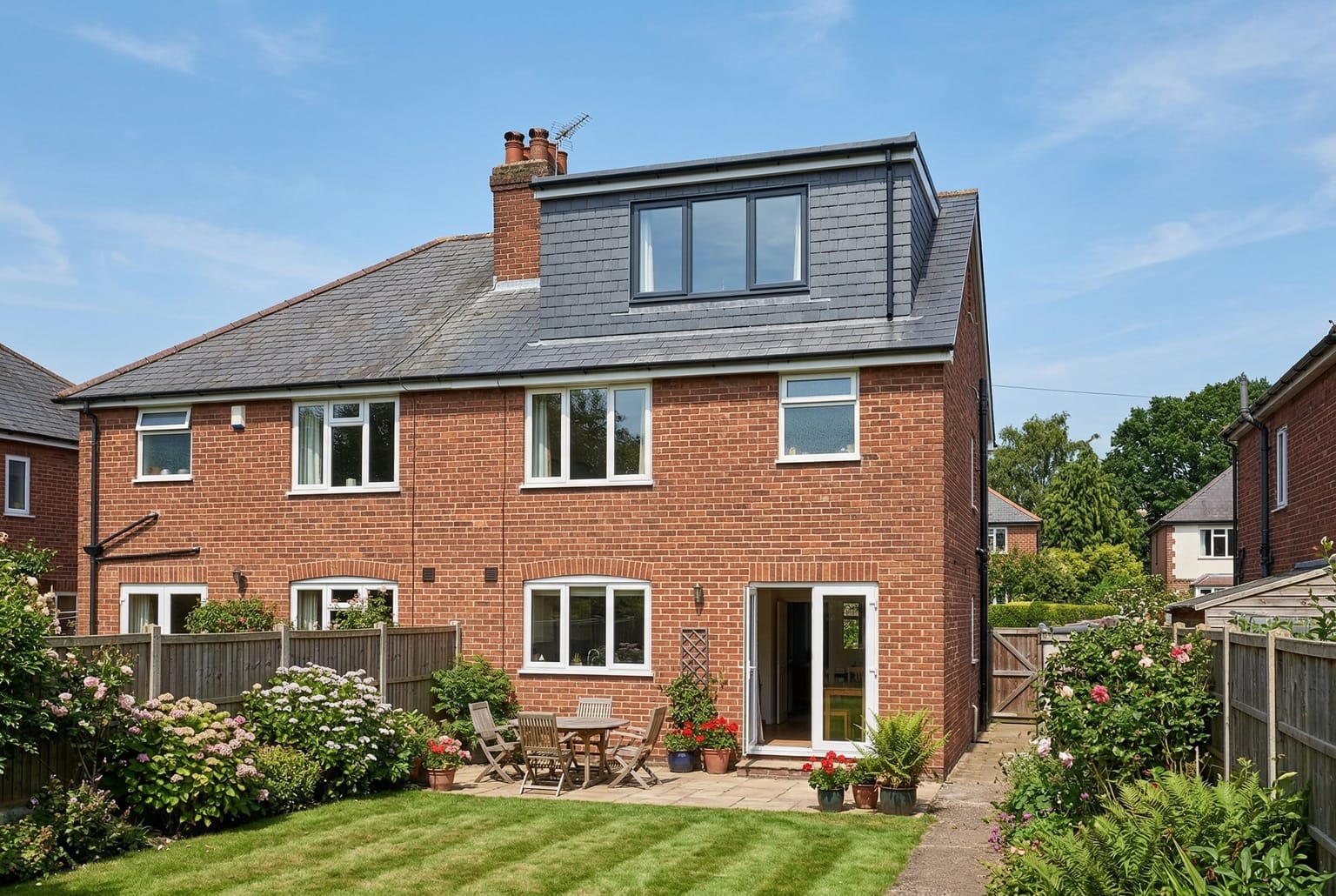
Permitted development (PD) rights let you carry out some work without applying for planning permission. For roof enlargements such as dormers and hip-to-gable extensions, the Planning Portal sets out these limits and conditions (Class B of the General Permitted Development Order):
Which homes qualify
- The rights apply to houses, not to flats or buildings containing flats.
- They do not apply on designated land — conservation areas, National Parks, Areas of Outstanding Natural Beauty, World Heritage Sites and the Broads.
- They do not apply to houses that have already been extended upwards, or were created, under certain other permitted development rights.
Volume limits
- Terraced houses: the roof enlargement must not add more than 40 cubic metres to the original roof space.
- All other houses: no more than 50 cubic metres.
Any previous roof enlargement counts towards the allowance.
Design limits
- The work must not be higher than the highest part of the existing roof.
- On the principal elevation facing a road, it must not extend beyond the existing roof slope.
- Materials must be similar in appearance to the existing house.
- No verandas, balconies or raised platforms, and no installing, altering or replacing chimneys, flues or soil and vent pipes.
- Side-facing windows must be obscure-glazed and, if they open, the opening part must be at least 1.7 metres above the floor of the room.
- The enlargement must be set back, so far as practicable, at least 20cm from the original eaves.
Rooflights that don't change the roof shape fall under separate rules (Class C), which is one reason rooflight (Velux) conversions often don't need planning permission.
When You Will Need Planning Permission
Mansard conversions
A mansard rebuilds the roof slopes, which normally goes beyond permitted development, so it usually needs planning permission.
Conservation areas and other designated land
Because roof enlargement rights don't apply on designated land, a dormer or hip-to-gable in a conservation area, National Park or Area of Outstanding Natural Beauty normally needs a planning application.
Listed buildings
If your home is listed, you will normally need listed building consent for alterations that affect its character, inside or out. The Planning Portal warns that carrying out work that needs listed building consent without it is a criminal offence.
Article 4 directions
Councils can remove some permitted development rights in particular areas using Article 4 directions. Check with your local planning authority whether one affects your home.
Flats and maisonettes
Permitted development rights for loft conversions do not apply to flats or buildings containing flats, so you will need to apply for planning permission.
Previous extensions
If the roof has already been extended, that volume counts towards the limit. Work out the total before assuming your plans are permitted development.
Building Regulations: Always Needed
Whether or not you need planning permission, the Planning Portal is clear that building regulations approval is required to turn a loft into a liveable space. Building regulations check things like:
- Structure — the new floor must be strong enough, and the stability of the existing roof must not be put at risk.
- Fire safety — in a typical loft conversion on a two-storey house, the Planning Portal says new fire-resisting doors, and sometimes partitions, are usually needed to protect the stairway, because escaping through windows from floors above the first floor is too dangerous. Mains-powered, interlinked smoke alarms are needed in the stairway at each level.
- Stairs — a proper stair to the new room is needed. Space-saving stairs may be possible; retractable ladders are not normally acceptable.
- Sound insulation — reasonable sound insulation between the new room and the rooms below.
- Insulation and ventilation — the new room must meet the energy efficiency standards in Part L and have suitable ventilation.
In a house built or refurbished before 2000, find out whether there is asbestos in the loft or roof before it is opened up. The National Asbestos Removal Centre, also run by Better Home Hub, explains when an asbestos survey is needed before building work.
You can apply for building control approval through your local council or use a private registered building control approver (GOV.UK). Registered building control approvers replaced the old "approved inspector" role in England from April 2024.
The Party Wall Act
If your loft conversion involves work on a party wall — common with terraced and semi-detached houses, for example cutting in steel beams — the Party Wall etc. Act 1996 is likely to apply in England and Wales. GOV.UK explains that:
- You must give your neighbour notice between 2 months and a year before the work starts.
- Your neighbour should respond in writing within 14 days. If they don't respond, or don't agree, the dispute process starts — you can't assume silence means consent.
- If you can't agree, one agreed surveyor or a surveyor for each side prepares a party wall award setting out what work happens, how and when, and who pays what.
HomeBuilding & Renovating's July 2026 guide puts party wall surveyor fees at around £1,000 to £2,500 or more.
Lawful Development Certificates
If you think your plans fall within permitted development, you can apply to your council for a Lawful Development Certificate confirming it. It isn't compulsory, but it gives you written proof that can help when you sell. GOV.UK says the fee for a certificate for proposed work is half the fee for the equivalent planning application.
Where Better Lofts Fits In
Better Lofts is an introduction service run by Better Home Hub Ltd. We don't design loft conversions or make planning, building control or party wall applications. If you send us an enquiry, Better Home Hub will try to introduce you to a loft conversion specialist in your area who can advise on what your project needs. You can also read about the different loft conversion types.